The right hernia surgeon must first identify the exact defect, distinguish it from other causes of a lump, and explain why one repair suits your anatomy and health better than another. By the end, you will know which symptoms need emergency care, what to ask during consultation, and how to compare surgeons in Thane without relying on a marketing label.
Key takeaways
- Seek emergency care for severe pain, vomiting, or a trapped, discoloured lump.
- Ultrasound or CT can confirm a hernia when examination is inconclusive.
- Repair choice depends on hernia location, size, recurrence, and your health.
- Verify the surgeon’s qualifications, hospital privileges, and experience with your repair type.
Which hernia locations cause a lump, and when is it an emergency?
A hernia usually appears as a bulge that becomes clearer when you stand, cough or strain and may flatten when you lie down. Location and surgical history help distinguish the common types:
| Location or history | Likely hernia | What to notice |
|---|---|---|
| Groin, extending toward the scrotum or labia | Inguinal | The most common groin location |
| Below the groin crease, upper inner thigh | Femoral | A smaller lump with higher complication risk |
| At the navel | Umbilical | A central belly-button bulge |
| Upper middle abdomen, between the breastbone and navel | Epigastric | Often a small, tender lump |
| Through a previous operation scar | Incisional | Appears at or beside the scar |
| At or near a previously repaired site | Recurrent | The lump returns after earlier repair |
A groin lump is not automatically an inguinal hernia; a femoral hernia, hydrocele, lymph node or another mass can look similar. A clinician records the site, size, reducibility, symptoms and previous operations. Do not rely on a belt or truss to treat a symptomatic hernia: it supports the bulge but does not close the defect.
Seek emergency assessment, not a routine appointment found through “hernia doctor thane”, if the lump becomes firm, very painful or impossible to push back, or if you develop:
- Vomiting or increasing abdominal swelling
- Inability to pass stool or gas
- Fever, rapidly worsening pain or skin colour changes over the lump
How does a surgeon confirm a hernia and decide whether to operate?
A surgeon usually confirms a hernia by examining you while standing and lying down, then asking you to cough or strain. The examination records the lump’s location, size, tenderness, reducibility, and whether it appears on both sides.
It also distinguishes a primary defect from a recurrent hernia and checks for other causes, such as a hydrocele, lymph node or diastasis recti.
During the examination, the surgeon checks:
- Whether the bulge enlarges with coughing or straining
- Whether it returns gently into the abdomen
- Whether the defect lies in the inguinal, femoral, umbilical, epigastric or scar area
- Whether pain, firmness, skin colour change or bowel symptoms suggest complication
Ultrasound adds value when the examination is uncertain, particularly with obesity, a small occult lump, a recurrent hernia or a woman with groin pain. CT is more useful for complex incisional or recurrent hernias, multiple defects, unclear abdominal pain, or suspected obstruction; it also maps the abdominal wall before difficult repair.
Watchful waiting can suit a man with a small, reducible, asymptomatic or minimally symptomatic inguinal hernia who understands the chance of later pain and has prompt access to care. Pain, activity limitation, enlargement or repeated difficulty reducing the lump favours elective repair.
Femoral hernias, groin hernias in women and complicated or irreducible hernias need a lower threshold for specialist assessment because obstruction and strangulation risk is higher. Ask a hernia specialist near Thane to explain that individual risk rather than relying on the label “best.”
Open, laparoscopic or robotic repair: which operation fits the hernia?
The best operation depends on the hernia’s location, size, recurrence and your ability to undergo general anaesthesia. A general surgery Thane search cannot identify the right technique by itself; the examination and surgical plan matter more.
| Option | Incision and anaesthesia | Mesh position, recovery and trade-offs |
|---|---|---|
| Open anterior repair | One incision over the hernia; local, regional or general anaesthesia may be suitable | Mesh sits in front of or behind the groin muscles. Recovery is reliable, but early wound pain and chronic groin pain can occur. |
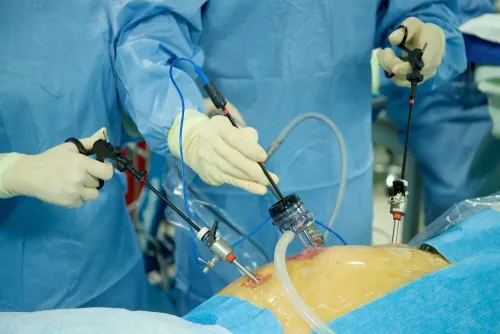
| Laparoscopic TEP or TAPP | Three small abdominal incisions; general anaesthesia is required | Mesh covers the inner abdominal wall from behind. It usually means less early pain and faster return to activity, especially for bilateral or recurrent hernias after open repair. |
| Robotic repair | Several small incisions; general anaesthesia is required | The mesh is placed posteriorly, as in laparoscopic repair. Greater instrument cost and operating time do not prove lower recurrence or chronic pain; experienced execution matters. |
Mesh repair lowers recurrence for most adult groin hernias, but does not remove infection, persistent pain or recurrence risk. A truss only supports the bulge temporarily; it does not close the defect and must not delay assessment of a firm, painful or irreducible lump.
Choose an open approach when you cannot tolerate general anaesthesia, have extensive abdominal adhesions, or have a recurrence after previous posterior repair. Laparoscopic or robotic repair may be unsuitable for a hostile abdomen, serious anaesthesia risk or limited local expertise. An open repair may also be preferable in an emergency strangulation case.
How do the hernia type and your health change the surgical plan?
The defect’s location, size, reducibility and history determine the repair; the same operation does not fit every bulge.
| Type | Planning difference |
|---|---|
| Inguinal | Mesh repair is common for adults; open or laparoscopic access depends on symptoms, sex, previous surgery and surgeon experience. |
| Femoral | Repair is usually advised promptly because the narrow opening has a higher risk of trapping bowel. |
| Umbilical | Small defects may suit suture repair; larger or high-tension defects often need mesh. |
| Epigastric | The surgeon assesses the gap and nearby defects; mesh becomes more useful as size and tension increase. |
| Incisional | CT may map several defects, muscle separation and old mesh before abdominal-wall reconstruction. |
| Recurrent | The approach often changes planes: previous open repair may favour laparoscopy, while previous laparoscopy may favour open repair. |
Mesh lowers recurrence for most adult groin repairs but can cause infection, chronic pain or recurrence; suture repair avoids mesh but fails more often when tension is high. Prior operations, scar tissue and old mesh change safe entry points and technique.
Obesity increases wound and recurrence risk, while smoking impairs healing and diabetes increases infection risk. Weight management, smoking cessation and glucose control improve elective readiness without delaying a painful or trapped hernia. Review blood thinners with the prescribing doctor; do not stop them yourself. Pregnancy usually favours observation unless obstruction or severe symptoms occur.
Treat persistent cough and constipation because straining loads the repair. Heavy physical work may require a staged return and tailored lifting restrictions. A search for best general surgeon in thane hernia should lead you to someone who explains these trade-offs for your anatomy, not just advertises one technique.
How can you choose and verify a hernia surgeon in Thane?
Do not choose a surgeon from a “best” label or a laparoscopic advertisement. “Best general surgeon in Thane for hernia” is not a recognised medical ranking. Compare a hernia doctor in Thane by qualification, verified registration, experience with your exact repair, and the safety plan after surgery.
- Check an MS in General Surgery or DNB in General Surgery, then verify the surgeon’s registration on the National Medical Commission’s Indian Medical Register. Registration confirms identity and licence, not hernia expertise.
- Ask how many repairs of your hernia type the surgeon performs each month, and how often they use the proposed open, TEP or TAPP technique.
- Ask who manages bleeding, infection, mesh problems, chronic pain or recurrence, and who covers urgent calls at night and on weekends.
- Confirm the review schedule, wound-care instructions, activity restrictions and contact number. Dr Aditya Phadke is one local surgeon to assess using these same questions, rather than relying on promotional wording.
| Question | What to ask | Why it matters |
|---|---|---|
| Diagnosis | Is this inguinal, femoral, umbilical, incisional, recurrent hernia or diastasis? | The repair plan differs. |
| Technique | Why open, TEP or TAPP for me? | Suitability depends on anatomy, previous surgery and health. |
| Results | What are your complication and recurrence rates for this operation? | A clear answer shows outcome tracking. |
| Backup | Who treats me after hours if pain, vomiting or a trapped lump develops? | Delayed help can turn a complication into an emergency. |
Related services
Hernia Surgery Best Hernia Surgery In Thane A hernia is a protrusion of the abdomen through the weakest part of the muscle and tissue that contains it. View service → |
Laparoscopic Hernia Surgery Best Laparoscopic Surgeon in Thane A hernia occurs when an internal organ or other body part protrudes through the wall of muscle or tissue that... View service → |
Frequently asked questions
Which hernia locations cause a lump, and when is it an emergency?
Groin, upper-thigh, belly-button, abdominal-incision, and upper-abdominal hernias can cause visible or palpable lumps. Seek emergency care if the lump becomes hard, severely painful, discoloured, cannot be pushed back, or is accompanied by vomiting, abdominal swelling, or inability to pass stool or gas.
How does a surgeon confirm a hernia and decide whether to operate?
The surgeon examines the lump while you stand, cough, strain, and lie down. Ultrasound can help when the diagnosis is uncertain; CT is useful for complex, recurrent, or postoperative hernias. Surgery depends on symptoms, hernia size and location, risk of trapping, progression, and your health.
Is open, laparoscopic, or robotic hernia repair best?
Open repair can suit many straightforward or very large hernias. Laparoscopic repair uses small incisions and often suits bilateral or recurrent groin hernias. Robotic repair uses articulated instruments but is not automatically better; the surgeon’s experience, hernia anatomy, cost, and hospital resources matter.
How do the hernia type and your health change the surgical plan?
Previous abdominal surgery, obesity, smoking, diabetes, blood thinners, lung disease, infection, and poor skin or tissue quality can change the operation, anaesthesia, mesh choice, and recovery plan. Treating modifiable risks before surgery can improve safety.
How can you choose and verify a hernia surgeon in Thane?
Check the surgeon’s medical registration, formal surgical qualifications, hospital affiliation, and experience with your specific hernia and proposed technique. Ask about mesh, anaesthesia, complications, recurrence, recovery time, total hospital charges, and what happens if the repair needs revision.
Keywords